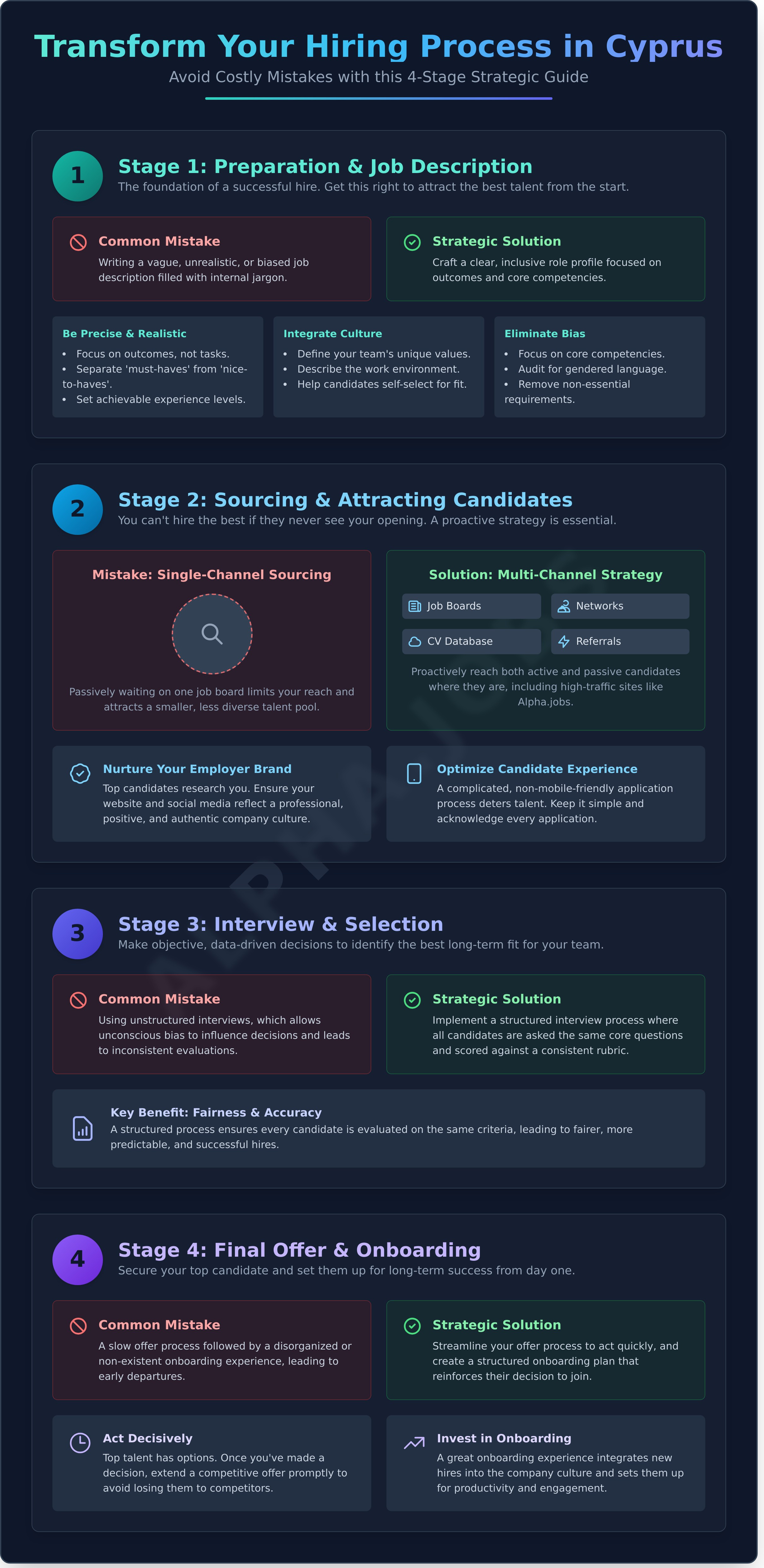
Top Hiring Mistakes Employers in Cyprus Make (And How to Avoid Them)

Alpha.jobs News By Alpha.jobs Published on February 9

Is your hiring process costing you more than just money? In the fast-paced Cypriot job market, watching top candidates accept offers from competitors while you’re still sifting through CVs is a frustrating and expensive reality for many businesses. These challenges often stem from the same root cause: avoidable hiring mistakes (mistakes during staff hiring). A single bad hire can set your company back thousands of Euros in wasted salary, recruitment fees, and lost productivity, significantly impacting team morale and your bottom line.

What if you could turn this around? This guide is designed to transform your recruitment from a costly gamble into a strategic advantage. We’ll expose the most common and damaging hiring mistakes made by employers in Cyprus, from writing poor job descriptions that repel top talent to ineffective onboarding that leads to early departures. By the end, you’ll have clear, actionable strategies to attract higher-quality applicants, streamline your process, and confidently build the strong, successful team your business deserves.

Key Takeaways

  • Start strong by crafting a precise and compelling job description to attract the right talent and set clear expectations from day one.
  • Go beyond a single job board. A multi-channel sourcing strategy is essential for reaching the best active and passive candidates in the Cypriot market.
  • Eliminate unconscious bias and make fairer decisions with a structured interview process. This is the most effective way to avoid common and costly hiring mistakes.
  • Secure your top choice by streamlining your offer process and creating an effective onboarding experience that reinforces their decision to join your team.

Table of Contents

  • Stage 1: Mistakes in Preparation and the Job Description
  • Stage 2: Errors in Sourcing and Attracting Candidates
  • Stage 3: Flaws in the Interview and Selection Process
  • Stage 4: Mistakes in the Final Offer and Onboarding

Stage 1: Mistakes in Preparation and the Job Description

The foundation of any successful hire is a well-defined role, yet many errors occur before the first application is even received. These initial hiring mistakes (mistakes in hiring staff) often stem from a rushed preparation phase. A poorly crafted job description not only attracts unsuitable candidates but also wastes valuable time and resources for your business. To set clear expectations from the start, it's crucial to treat this stage as the most critical step in the overall process of recruitment.

Writing Vague or Unrealistic Job Descriptions

An effective job description is a strategic tool, not just a list of tasks. To attract the right talent in Cyprus, you must be clear and realistic. Avoid internal jargon that confuses external applicants and set achievable experience requirements that won't discourage promising candidates. The goal is to create a clear picture of success in the role.

  • Focus on outcomes and responsibilities, not just daily duties.
  • Clearly separate 'must-have' qualifications from 'nice-to-have' skills.
  • Set realistic experience levels; asking for 10 years of experience for a junior role will filter out great potential.

Ignoring Company Culture Fit

A skills match is only half the battle. A new hire who doesn't align with your company’s values and work environment can disrupt team dynamics and lower morale. Define what makes your team unique and integrate it into the job description. Mention your work environment-whether it's collaborative, fast-paced, or autonomous. This transparency helps candidates self-select, ensuring a better long-term fit for everyone involved. Some of the most costly hiring mistakes happen when culture is ignored.

Creating a Biased 'Wish List' Instead of a Role Profile

It's easy to create a job description based on an imaginary 'perfect' candidate, but this often leads to a biased and exclusionary wish list. Instead, focus on the core competencies essential for success in the position. Audit your descriptions for gendered language (e.g., "salesman") or unnecessary requirements that may deter a diverse pool of applicants. A diverse team is proven to be more innovative and resilient, giving your business a competitive edge.

Stage 2: Errors in Sourcing and Attracting Candidates

You can't hire the best person for the job if they never see your opening. In today's competitive Cypriot market, passively waiting for applications is a strategy for mediocrity. Top talent is often already employed and not actively looking. To attract them, you need a proactive, multi-channel strategy that showcases your company as a premier place to work and avoids critical sourcing errors.

Relying on a Single Sourcing Channel

Posting a job on your company website and hoping for the best is one of the most common hiring mistakes. To maximise your reach and connect with a diverse pool of qualified candidates, you must expand your strategy. A modern recruitment plan is a multi-channel plan.

  • Diversify Job Postings: Go beyond your own site. Utilise dedicated, high-traffic job boards like Alpha.jobs to reach a wide and active audience of job seekers across Cyprus.
  • Leverage Professional Networks: Use platforms like LinkedIn to share your openings, engage with industry professionals, and build a talent pipeline.
  • Be Proactive, Not Passive: Don't just wait for applications to come to you. For specialised or senior roles, you can proactively search our CV database for qualified candidates who match your exact criteria.
  • Use Referrals Wisely: Employee referral programs are valuable for finding culturally aligned candidates, but they shouldn't be your only source, as this can limit diversity.

Neglecting Your Employer Brand

Before applying, skilled candidates will research your company. What will they find? Your employer brand is your reputation as a place to work, and it's a critical asset in attracting top talent. Ensure your company website and social media profiles are professional, up-to-date, and reflect an authentic view of your company culture. A strong, positive brand acts as a magnet, making your company a destination for high performers.

Creating a Poor Candidate Experience

A complicated or lengthy application process is a major deterrent. If it takes more than a few minutes or isn't mobile-friendly, many qualified candidates will simply give up. This is their first real interaction with your company, and a poor experience suggests a disorganized or uncaring workplace. Acknowledging every application with an automated confirmation email is a simple step that shows respect. Fixing this process prevents easily avoidable hiring mistakes that can damage your reputation long-term.

Stage 3: Flaws in the Interview and Selection Process

You’ve attracted a strong pool of candidates, but the interview and selection stage is where many well-intentioned hiring processes fall apart. This is where subjectivity, bias, and a lack of structure can derail your efforts, leading to a poor hiring decision. The most common hiring mistakes (mistakes during personnel hiring) happen here, but they are entirely avoidable with a disciplined approach. A standardised process is your best defence, ensuring every candidate is evaluated fairly and objectively against the core requirements of the role.

Conducting Unstructured Interviews

An unstructured interview that feels more like a casual chat is an unreliable predictor of future job performance. While building rapport is important, your primary goal is to gather concrete evidence of a candidate's skills and experience. To add structure and gather meaningful data:

  • Prepare standard questions: Ask every candidate for the same role the same core set of questions to create a level playing field.
  • Use behavioural questions: Phrases like, "Tell me about a time when..." prompt candidates to provide real-world examples of how they have handled specific situations in the past.
  • Involve the team: Including multiple interviewers provides diverse perspectives and helps mitigate the bias of a single individual.

Letting Unconscious Bias Drive Decisions

Every person has unconscious biases, and they can significantly cloud judgement during hiring. Common examples include the 'first impression' bias (making a snap judgement) or the 'like me' bias (favouring candidates who share similar backgrounds or personalities). To counter this, focus on objective evaluation. Use a scoring rubric to rate each candidate against pre-defined criteria like skills, experience, and cultural contribution. A diverse hiring panel is also one of the most effective tools for challenging individual biases and ensuring the focus remains on who is truly best for the job, not just who made the best connection.

Failing to Communicate with Candidates

In a competitive market like Cyprus, top talent has options. Failing to communicate clearly and promptly is a critical error that can cost you your best candidates and damage your employer brand. Ghosting applicants-simply never responding after an interview-is unprofessional and leaves a lasting negative impression. Remember that even rejected candidates could be future customers, partners, or even applicants for another role. Keep all candidates informed of the timeline and their status. A simple, respectful rejection email is far better than silence and shows you value the time they invested in your company.

Stage 4: Mistakes in the Final Offer and Onboarding

You've interviewed, deliberated, and finally chosen the perfect candidate. The recruitment process is over, right? Not quite. The final stages-extending the offer and onboarding the new employee-are where many companies stumble, turning a potential success into a costly mistake. These final steps are not just administrative; they are critical for securing your investment, improving retention, and setting your new hire up for long-term success.

Taking Too Long to Make an Offer

In Cyprus's competitive job market, top candidates don't wait around. They often have multiple offers on the table, and a delay from your side can be the deciding factor-for another company. A slow process signals indecisiveness and disorganisation, making candidates question your company's efficiency. To avoid this, streamline your internal approval process before you even post the job. Once you've made a decision, act swiftly and decisively to extend a compelling offer.

Having a Non-Existent Onboarding Process

The first week sets the tone for an employee's entire tenure. Throwing a new hire into the deep end with no structure is one of the most damaging hiring mistakes (mistakes during personnel hiring). A strong onboarding process shows you are invested in their success and ready for them to contribute.

  • Be Prepared: Have their equipment, accounts, and workspace ready before day one. Nothing is more demotivating than showing up and not being able to work.
  • Create a Plan: Develop a structured 30-60-90 day plan that outlines key goals, training milestones, and initial projects.
  • Assign a Buddy: Pair them with a tenured colleague who can help them navigate the company culture and answer informal questions.

Failing to Sell the Role and Company

Remember, the interview process is a two-way street. The best candidates are evaluating you just as thoroughly as you are evaluating them. Throughout the final stages, continue to articulate the company’s vision and the specific growth opportunities tied to the role. Reinforce why your company is the best choice for their career. The best candidates are choosing you as much as you are choosing them.

By avoiding these final-stage pitfalls, you ensure your recruitment efforts pay off. A thoughtful offer and a structured onboarding process are the foundation for a productive and long-lasting professional relationship. Avoiding these common hiring mistakes will significantly boost your retention rates and build a stronger team.

Ready to build a hiring process that attracts and retains top Cypriot talent? Post your job on Alpha.jobs now!

Elevate Your Hiring Strategy in Cyprus

Navigating the Cypriot job market requires a thoughtful and strategic approach. As we've explored, hiring is a multi-stage process where small oversights-from an unclear job description to an unstructured interview-can lead to costly outcomes. By understanding and sidestepping these common pitfalls, you do more than just fill a vacancy; you invest in your company's future. Proactively avoiding these hiring mistakes is the first step towards building a resilient and high-performing team.

The right tools and partner can transform your recruitment process from a challenge into a strategic advantage. Join the ranks of over 24,000 employers across Cyprus who rely on Alpha.jobs, The #1 Job Platform in Cyprus. Gain unparalleled access to a dynamic database of thousands of active CVs and connect with the skilled professionals you need to grow your business.

Don't let hiring mistakes hold you back. Find your next great hire in Cyprus. Post a job on Alpha.jobs today!

Frequently Asked Questions

What is the average cost of a bad hire in Cyprus?

The cost of a bad hire extends far beyond salary. It includes recruitment fees, training resources, lost productivity, and potential damage to team morale. In Cyprus, a conservative estimate places this cost at 30% or more of the employee's first-year salary. For a role earning €35,000 annually, this translates to a loss of over €10,500. This financial impact underscores why avoiding common mistakes during personnel hiring is critical for sustainable business growth.

How long should a typical hiring process take from posting a job to making an offer?

While it varies by industry, a typical professional hiring process in Cyprus should take between three to six weeks from posting the job to making an offer. This timeline generally includes one week for applications, one to two weeks for screening and interviews, and one final week for deliberations and the offer. A streamlined and decisive process is essential to secure top candidates in a competitive market before they accept another opportunity.

Is it a legal requirement to provide feedback to rejected candidates in Cyprus?

There is no specific legal requirement in Cyprus to provide detailed feedback to rejected candidates. However, it is a highly recommended best practice to maintain a positive employer brand. A simple, professional email informing candidates that the position has been filled provides closure and shows respect for their time. This simple courtesy can encourage them to apply for future roles and speak positively about their experience with your company.

How can we compete for talent if we can't offer the highest salary?

If you can't offer the highest salary, focus on what makes your company a great place to work. Highlight non-monetary benefits such as flexible working hours, remote work options, and a supportive company culture. Emphasize opportunities for professional development, training, and clear career progression. Benefits like private health insurance or a 13th salary are also powerful incentives in the Cypriot market. Clearly communicate this total value proposition during the hiring process.

What are the most important things to include in a job offer letter?

A professional job offer letter must be clear and comprehensive to prevent misunderstandings. Key elements to include are the official job title, gross monthly and annual salary in Euros (€), the specific start date, and standard working hours. Also, outline essential benefits like annual leave entitlement, health insurance plans, and any bonus structures. Finally, specify the reporting manager and mention any pre-employment conditions, such as a probationary period.

How can I ensure our interview process is fair and unbiased?

To ensure a fair process, use structured interviews with a standard set of skills-based questions for all candidates. Involve a diverse panel of interviewers to mitigate individual unconscious bias and gain a more rounded perspective. Incorporate a practical assessment or work sample test that directly relates to the job's core functions. This data-driven approach helps you avoid critical mistakes during personnel hiring and select the best candidate based on merit.